Buying the right AC in 2026 comes down to five decisions:
- Choose a reliable brand, Calculate correct tonnage,
- Match star rating with usage hours,
- Prefer inverter technology, and ensure long compressor warranty.
- Smart AC features are optional.
- Older models (2025) still offer excellent value without missing meaningful upgrades.
The Ultimate 1-Minute AC Buying Guide (2026): What Actually Matters?

Why is choosing the right AC brand important in 2026?
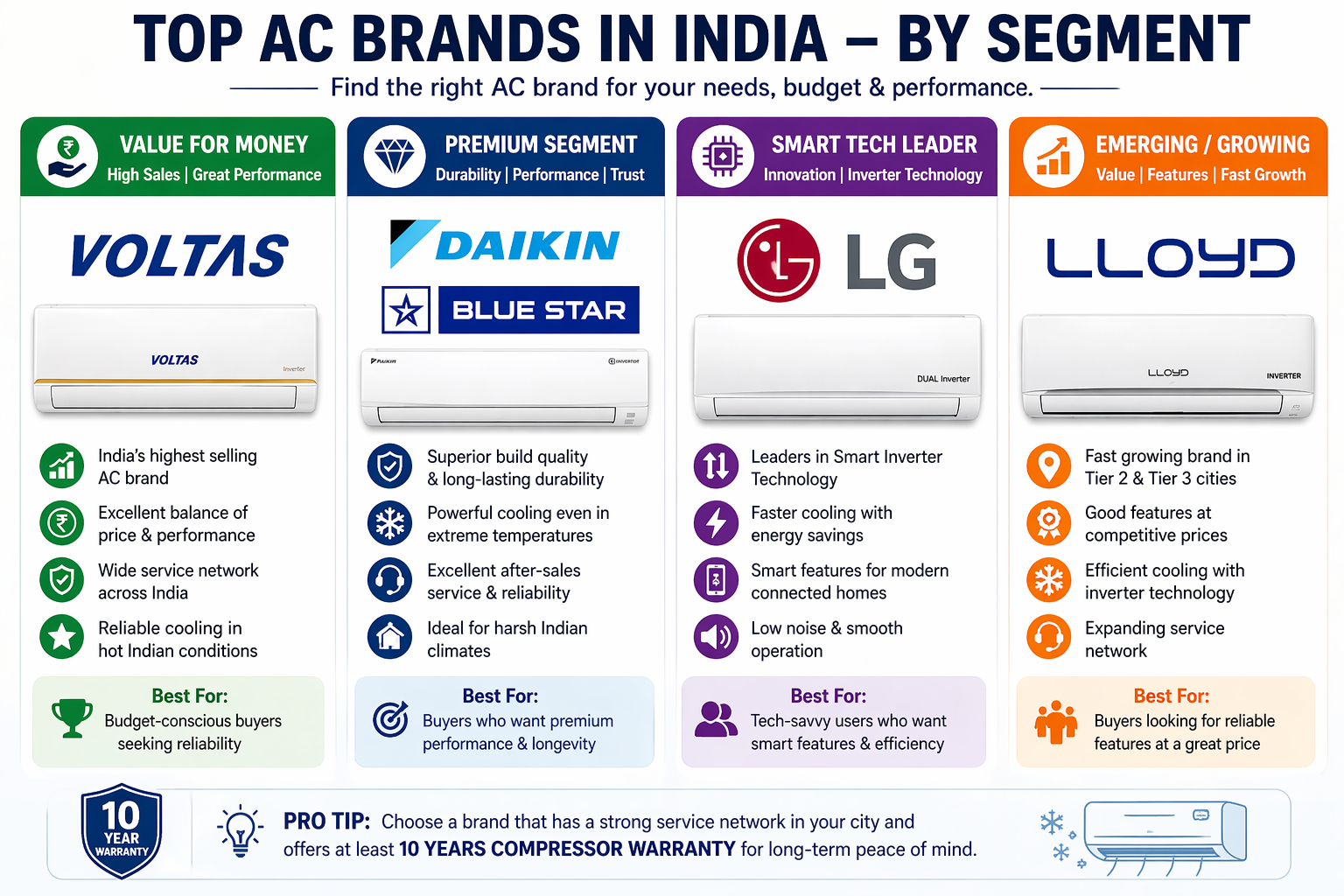
When I evaluate air conditioners, brand reliability still plays a huge role in long-term satisfaction. In India, different brands dominate different segments, and understanding this helps you avoid overpaying or underbuying. Value-for-money brands like Voltas consistently lead in sales because they balance price and performance well. Premium brands such as Daikin and Blue Star are known for durability and strong cooling even in extreme climates. LG stands out with its smart inverter technology, which improves efficiency and performance. Meanwhile, Lloyd is rapidly growing, especially in Tier 2 and Tier 3 cities, offering competitive pricing with decent features.
From my experience, the “best brand” depends less on marketing and more on your usage, budget, and service availability in your city. Always prioritize brands with strong after-sales support in your area—it matters more than small feature differences.
How do you calculate the right AC tonnage for your room?
Choosing the correct tonnage is one of the most critical decisions because an undersized AC will struggle to cool, while an oversized one wastes electricity and cycles inefficiently. I always recommend using an online tonnage calculator where you input room size, ceiling height, sunlight exposure, and occupancy. Based on this, the system suggests whether you need a 1-ton, 1.5-ton, or 2-ton AC.
As a quick rule: small bedrooms typically need 1 ton, medium rooms 1.5 ton, and larger living spaces 2 ton or more. But don’t rely only on rough estimates—factors like top-floor heat, window size, and insulation can significantly affect cooling needs. A properly sized AC not only cools faster but also improves energy efficiency and lifespan, making this step far more important than most people realize.
Which star rating AC should you choose based on usage?
Energy efficiency directly impacts your electricity bill, and star ratings are the simplest way to judge that. From my observation, the right choice depends entirely on how many hours you use your AC daily. If your usage is limited to 4–5 hours, a 2-star or 3-star AC is sufficient and more cost-effective upfront. However, if you use your AC for 10–12 hours daily—especially overnight—you should invest in a 4-star or 5-star model to save significantly on long-term electricity costs.
In hotter regions where ACs run almost continuously, higher star ratings quickly pay for themselves. The mistake I often see is people overspending on 5-star units despite low usage or underinvesting when usage is high. Match the rating to your real-life pattern—not assumptions—and you’ll get the best return on investment.
Should you buy an inverter AC in 2026?
Inverter technology is no longer optional—it’s the standard I recommend in almost every case. Unlike fixed-speed ACs, inverter ACs adjust compressor speed based on cooling demand, which reduces electricity consumption and maintains consistent temperature. From my experience, they also cool faster and operate more quietly.
In 2026, most meaningful innovation in ACs revolves around efficiency rather than radical new features, and inverter systems are at the center of that shift. They are particularly useful if your AC runs for long hours or if your room experiences fluctuating heat loads throughout the day. While they cost slightly more upfront, the energy savings and comfort gains justify the investment. Simply put: if you’re buying a new AC today, choosing a non-inverter model rarely makes sense.
Do you really need a smart AC?
Smart ACs add convenience, but they are not essential for everyone. These models allow you to control temperature, schedules, and modes remotely via mobile apps—even when you’re not at home. Personally, I find them useful for pre-cooling rooms before arrival or managing energy usage more efficiently.
However, this convenience comes at an additional cost of around ₹4,000–₹5,000. If you value automation and remote access, it’s worth it. If you just want reliable cooling, you can skip it without missing core functionality. In 2026, smart features are improving, but they still fall under “nice-to-have” rather than “must-have.” Focus first on performance, efficiency, and durability—then consider smart features as an add-on.
What warranty and features should you never ignore?
Warranty is one of the most overlooked yet critical factors when buying an AC. I always advise checking compressor and PCB (Printed Circuit Board) warranties carefully. A good AC should come with at least a 10-year compressor warranty. Since the compressor is the most expensive component, this ensures long-term peace of mind.
Additionally, if you live in regions with extreme temperatures—like very hot summers and cold winters—consider a hot and cold AC. This allows year-round usage, replacing the need for separate heating solutions. Also, look for fast cooling modes and durable build quality rather than gimmicky features. In my experience, a strong warranty combined with reliable core performance matters far more than flashy marketing claims.
Should you buy the latest AC model or go for older ones?
Many buyers assume that newer models always offer better technology, but that’s not entirely true. From what I’ve seen, most significant AC innovations already happened around 2023, especially in inverter efficiency. Since then, upgrades have been incremental rather than revolutionary.
This means 2025 models often provide excellent value at lower prices without sacrificing meaningful features. If you find a good deal on a slightly older model, you can confidently go for it. The key is to ensure it still meets your requirements in terms of tonnage, star rating, and warranty. Don’t overpay just for a newer launch year—focus on real-world performance instead.
Quick Decision Framework (5-Step Buying Checklist)
| Step | What to Decide | Recommendation |
|---|---|---|
| 1 | Brand | Choose based on budget + local service support |
| 2 | Tonnage | Use calculator (1T / 1.5T / 2T based on room) |
| 3 | Star Rating | 2–3 star (low use), 4–5 star (high use) |
| 4 | Technology | Always prefer inverter AC |
| 5 | Extras | Smart features optional, warranty essential |
FAQs: AC Buying in 2026
1. Is a 5-star AC always better?
Not necessarily. It’s better only if you use your AC for long hours daily. Otherwise, the higher upfront cost may not justify the savings.
2. How important is inverter technology?
Very important. It improves efficiency, cooling speed, and comfort, making it the best choice for almost all users today.
3. Can I trust older AC models like 2025 versions?
Yes. Most core technology hasn’t changed significantly, so older models often provide better value for money.
4. Do smart ACs increase electricity consumption?
No, they don’t inherently consume more power. In fact, smart scheduling can sometimes help reduce energy usage.
5. What’s the biggest mistake people make when buying an AC?
Choosing the wrong tonnage. It directly affects cooling performance, efficiency, and long-term satisfaction.
Leave a Reply Cancel reply